
Conscious Fridays: How Inner Peace Changes Relationships
The healthier our relationship with ourselves, the healthier our relationships with others naturally become.
We often think about improving our relationships by focusing on the other person.
How can I communicate better?
How can I stop arguing?
How can I get my partner to understand me?
How can I set better boundaries?
These are worthwhile questions. But there is another question that may be even more transformative:
How am I relating to myself?
Because the relationship we have with ourselves quietly shapes the way we experience almost every other relationship in our lives. When we feel disconnected from ourselves, we may look outside ourselves for reassurance, validation, safety, or a sense of worth. We may become overly accommodating, defensive, controlling, withdrawn, or reactive. But as we develop a deeper sense of inner peace, something begins to change. We don't necessarily become less passionate or stop caring about other people.
We simply become less dependent on other people to create our sense of peace. And that can change everything.
Make it stand out
When We Are Not at Peace Within Ourselves
Relationships can sometimes become places where we unconsciously try to resolve our own inner discomfort. We might seek constant reassurance because we don't feel secure within ourselves. We might become angry when someone disagrees with us because disagreement feels threatening. We might struggle to say no because we fear disappointing someone. We might tolerate relationships that don't feel healthy because being alone feels more uncomfortable than remaining connected.
Or we might become highly independent—not because we genuinely don't need anyone, but because depending on someone else once felt unsafe. None of these responses make us "bad" at relationships. They are often strategies we learned somewhere along the way to help us feel safe, connected, or worthy. The invitation isn't to judge these patterns. It is to become curious about them.
Inner Peace Creates Space Between Feeling and Reaction
One of the most powerful changes that comes with greater self-awareness is the ability to pause. Something happens. We feel hurt, angry, rejected, frightened, or misunderstood. And instead of immediately reacting, we notice:
"Something is happening inside me right now."
That tiny space can be transformative. Rather than automatically sending the angry text, withdrawing, criticizing, pleasing, or defending ourselves, we have an opportunity to ask:
What am I actually feeling?
What do I need?
What story am I telling myself about what just happened?
Is this about what is happening now—or is something older being activated?
This is where emotional regulation becomes so important. A regulated nervous system doesn't mean we never become upset. It means we have greater capacity to experience difficult emotions without being completely controlled by them. And when we can stay connected to ourselves during difficult moments, we can stay more connected to the people around us, too.
What Story Am I Telling Myself?
Once we've named the emotion, we can become curious about the story surrounding it. When something happens in a relationship, we don't simply experience the event itself. We immediately create a story about what it means.
Someone doesn't call us back. The fact is: They didn't call. But the story might be: They don't care about me. I've done something wrong. They always put me last. I can't trust them. People always leave.
The fascinating thing is that, over time, our stories can become beliefs. And once a belief becomes deeply established, we often stop experiencing it as a belief at all. We experience it as fact. We don't think: "I have a belief that people can't be trusted." We think: "People can't be trusted." We don't think: "I have a story that I'm not important." We think: "I'm not important."
And because our minds naturally look for information that confirms what we already believe, we can begin noticing the moments that support our story while overlooking the moments that don't. Our belief becomes a lens through which we interpret the world. And this is where our stories can begin to limit us.
If I believe that people will always disappoint me, I may never allow myself to become truly vulnerable. If I believe that my needs are a burden, I may never ask for what I need. If I believe that conflict means a relationship is unsafe, I may avoid necessary conversations. If I believe that I am unworthy of love, I may unconsciously accept relationships that reinforce that belief.
The story creates the belief. The belief influences our perception. Our perception influences our behavior. And our behavior can then create experiences that seem to prove the original story was true. It's a powerful loop.
But here's the liberating part:
A story is not necessarily a fact. A belief is not necessarily the truth. And just because we've believed something for a very long time doesn't mean we have to continue believing it. When we become conscious of the stories we're carrying, we can begin to question them: Is this actually a fact—or is this my interpretation of what happened? Where did I learn this story? What experiences have reinforced it? Is there another possible explanation? What might become possible if this belief weren't running the show?
We don't have to replace every difficult thought with a positive affirmation. We simply begin to create space around the belief. And in that space, something incredibly important becomes possible:
Choice.
Instead of automatically living from an old story, we can begin asking what is actually true now. That is one of the gifts of inner work. We don't necessarily change what happened in our past. We change the meaning we continue to give it—and therefore the possibilities available to us in the present.
We Stop Asking Others to Complete Us
There is a profound difference between wanting connection and needing someone else to make us feel whole. Healthy relationships don't require us to become completely self-sufficient. We are human beings. We need one another. But when we cultivate a stronger relationship with ourselves, connection becomes a choice rather than a desperate attempt to fill an internal void. We can love someone deeply without losing ourselves. We can miss someone without believing we cannot be okay without them. We can appreciate someone's approval without needing it to determine our worth. We can hear criticism without automatically believing that something is wrong with us. And we can allow another person to have their own feelings without immediately taking responsibility for fixing them. This is where healthy boundaries begin to emerge naturally.
Inner Peace Changes the Way We Communicate
When we're internally overwhelmed, communication can easily become about protection. We defend. We blame. We criticize. We withdraw. We try to win. But when we feel more grounded within ourselves, communication can become about connection instead. Instead of: "You never listen to me." We might be able to say: "I felt unheard in that conversation, and I'd really like to try again." Instead of: "You don't care about me." We might say: "I'm feeling disconnected from you and I'd like to find our way back to each other." The difference isn't simply better communication technique. It comes from a different internal starting point. We are no longer communicating primarily from our defense system. We're communicating from a place of greater awareness.
Peace Doesn't Mean Avoiding Conflict
It's important to understand that inner peace doesn't mean becoming endlessly calm, agreeable, or passive. Healthy people still get angry. They still disagree. They still have difficult conversations. They still say no. They still leave relationships that are unhealthy. In fact, inner peace can make us more capable of doing these things. When we aren't terrified of conflict, we can have honest conversations. When we aren't dependent on everyone's approval, we can establish boundaries. When we trust ourselves, we can tolerate someone else's disappointment. And when we know that our worth isn't dependent upon being liked, we become freer to show up authentically.
Peace isn't the absence of boundaries or difficult emotions.
It's the ability to remain connected to ourselves while experiencing them.
The Relationship With Yourself Comes First
Imagine speaking to yourself the way you speak to someone you deeply love. Would you be patient? Would you listen? Would you allow yourself to make mistakes? Would you acknowledge your needs? Would you give yourself permission to rest? Would you celebrate your progress instead of constantly focusing on what isn't good enough? For many of us, the voice inside our own heads is far harsher than the voice we would ever use with another person. Cultivating inner peace begins, in part, with changing that relationship. It can begin with something very simple:
Notice how you speak to yourself.
Then ask: "Would I speak this way to someone I love?"
If the answer is no, experiment with a different voice. Not falsely positive. Not dismissive. Just kinder. More honest. More compassionate. Over time, the way we relate to ourselves becomes the foundation from which we relate to everyone else.
A Conscious Friday Practice: Name It Before You Explain It
The next time you notice yourself becoming irritated, defensive, anxious, hurt, or emotionally activated in a relationship, pause before responding.
Take one slow breath.
Before you decide why you feel this way—or what the other person's behavior means—try to simply name the emotion.
This can be surprisingly difficult. We often use broad words like angry, sad, or stressed without looking more closely at what is underneath.
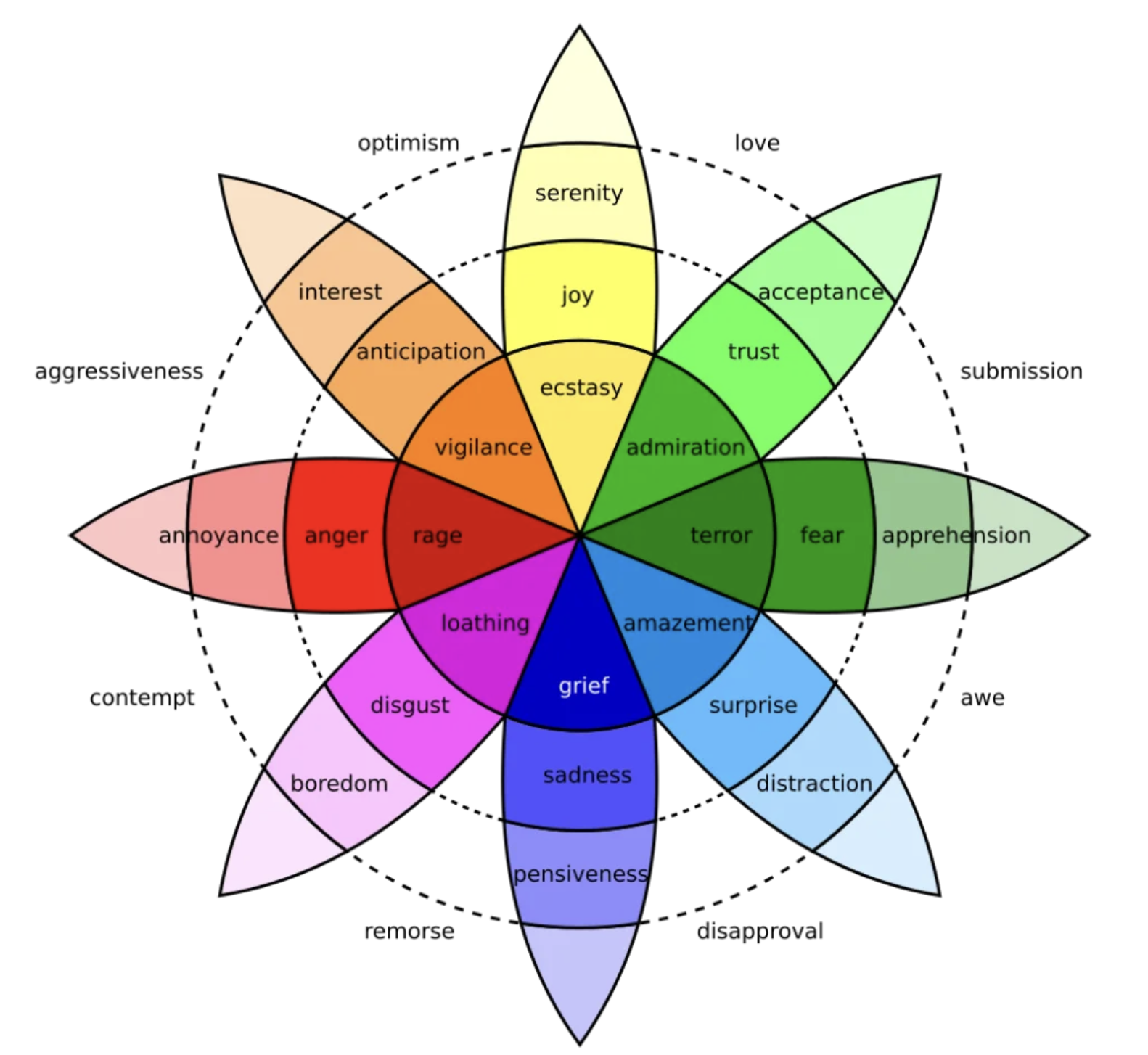
An emotion wheel can be a wonderful tool for this. Gloria Willcox's Feelings Wheel, for example, moves from broad emotional categories toward increasingly nuanced feelings, helping us find a more precise word for our experience. Robert Plutchik's Wheel of Emotions offers another framework, showing how emotions can relate to one another, vary in intensity, and sit in relationship to their opposites.
Instead of simply saying:
"I'm angry."
You might discover:
"I'm actually disappointed."
Or:
"I'm hurt."
"I feel rejected."
"I'm frightened."
"I feel betrayed."
"I'm overwhelmed."
That distinction matters.
The more precisely we can name what we're experiencing, the more space we create between the feeling and the story we attach to it.
Then ask yourself:
What am I feeling?
Name the emotion without judging it.
What am I needing?
Perhaps it's reassurance, space, respect, rest, understanding, or simply a moment to breathe.
What story am I telling myself about this feeling?
Are you assuming someone's intentions?
Are you predicting what will happen?
Are you interpreting their behavior through an old wound?
And finally:
How can I respond from the person I want to be rather than from the emotion I am experiencing?
You don't have to get it perfect.
The practice is simply learning to create a little more space between what happens, what you feel, the story you tell yourself about it, and how you choose to respond. That space is where choice lives.
A Moment to Reflect
Take a quiet moment today and consider:
How is my relationship with myself showing up in my relationships with others?
Where am I seeking outside myself something I might begin cultivating within? Where could I create a little more space before reacting? Where might I practice a little more compassion—for myself or someone else?
And perhaps most importantly:
What would change if I trusted myself a little more?
Inner peace doesn't mean avoiding difficult emotions or becoming endlessly calm. It means learning to notice what we're feeling, question the stories we're telling ourselves, and remain connected to ourselves while choosing how we respond.
The healthier our relationship with ourselves, the healthier our relationships with others naturally become.
About Maui Healing Retreat
At Maui Healing Retreat, we create space for deeper self-awareness, nervous-system regulation, healing, and conscious transformation. Our retreats offer an opportunity to step away from the noise of everyday life, reconnect with yourself, and explore the patterns that shape how you experience yourself and your relationships.
If you feel called to go deeper, explore our transformative retreat experiences at Maui Healing Retreat.